12 Sep How Many Versions of Yourself Do You Have?
(Two-legged versions)
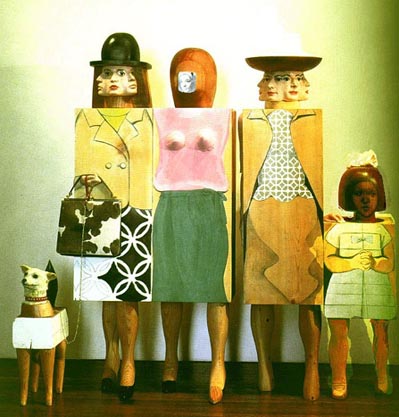
Women and Dog by Marisol Escobar (public domain)
How Many Versions of Yourself Do You Have?
Uncovering and Becoming the True You
By Ruth Schimel PhD, Career & Life Management Consultant, Author
www.ruthschimel.com ruth@ruthschimel.com 202.659.1772
©2025. 4th DRAFT FOR COMMENT, IMPROVEMENT APPRECIATED
Not for commercial use or sharing without Ruth’s permission.
What you’ll get from this article. Do you find yourself acting differently depending on the context, people involved or who you’re trying to please? Maybe your behavior just varies with your mood or deeper matters such as your goals and fears. Certainly, combinations of these influences are possible as you continue to appreciate and express the true you over time.
Given the curiosity and concerns many of us have about our authentic selves, this article is designed specifically to encourage both your inquiry and attention to what you do and say. Without losing spontaneity, attending to your behavioral choices, emotions and situations in the moment will give you the immediate power of choice. With that comes self-awareness and self-knowledge. It’s also an opportunity to celebrate the processes involved with who you are now and who you want to become. Seems a pretty quick, rich gift to me for a small investment of time.
That awareness puts the keys to your conscious control and comfort right in your hands. Then you’ll be more likely to relax and enjoy yourself, to become increasingly confident. As you use your influence and develop effective connections from and with others, you’ll create opportunities for promising situations to be generally, genuinely happier and more successful, however you define both. http://bit.ly/4kj7D0J
Situations are not always neat and predictable, but your core self can provide stability. As you have probably noticed in yourself and others, no one is entirely consistent. Differing situations, emotions and life experiences, not to mention genetic and epigenetic predispositions, make always being true to yourself challenging, even inappropriate occasionally.
For many, the search for self continues to be dynamic and often ongoing. One extreme example of self-inquiry is Walt Whitman who kept trying with prose and photography. Maybe that’s why he said he contains multitudes! https://bit.ly/40vYElA
And perhaps that’s why some people seem addicted to taking selfies, possibly for reassurance of their existence as well as to capture the moment. https://petapixel.com/2023/04/28/scientists-explain-why-people-love-to-take-selfies/
So the ways you honor your true self can vary as they capture your process of becoming. How can this ever end as you keep interacting with others and the shifting environment and as your habits, memories and tendencies modify? Your ambitions and anxieties are also part of the dynamic puzzle of growth. In sum, the full picture or knowing who you think you are continues and may even be illusive at times: https://www.nytimes.com/2021/09/02/opinion/brain-realityimagination.html?unlocked_article_code=1.Uk8.3bny.e3nmKgtcbObI&smid=url-share
But don’t give up your inquiry; the insights and development have rewards and offer direction. And taking action per se often builds the muscles of your central nature, your core self.
Here is the AI overview: The term “core self” refers to an individual’s fundamental sense of self, encompassing their most authentic and stable qualities. It’s often described as the inner wisdom, the wise self, or the true self, and is characterized by qualities like compassion, curiosity, clarity, and confidence. It’s considered the foundation upon which other aspects of self, like self-concept and identity, are built.
How your past behaviors and situations influence the present.
To remind yourself of how past roles and experiences infiltrate present selfpresentations, for better and worse, jot down a few key words and associations related to each following bullet:
• The main three to five basic roles you’ve had in your life and work so far.
• Which ones have the most satisfying, engaging memories? Describe a few, if you wish.
• How do the roles differ, inter-relate and cross fertilize?
• In retrospect, how would you modify one of the less healthy, productive ones now?
• These days, what main prospects excite, encourage or motivate you to act?
Based on my own observations at work, in various cultures and my lived experiences over time, I noticed how my behaviors sometimes reflected situations as much as my intrinsic nature. For example, when I visited with my parents as an adult, we all seemed to regress into some previous automatic ways of relating that did not benefit any of us.
Though I could not change their behaviors, the more I became aware of my own regression and could laugh at myself, the less I succumbed to those automatic old habits. Over time, the more confident, self-aware and engaged I was, the truer to myself I became. What have you noticed about your own behavior in one situation when you caught yourself regressing or succumbing to previous limiting habits?
Who are you now? Describe in several sentences who you are professionally and personally these days. Jot down main themes to integrate. Perhaps string the ideas into a pithy summary, writing several sentences to capture the essence. A start may be a little rocky as was mine. I first came up with something accurate, but a little soulless with just some titles: career and life management consultant and author.
How would you give these titles some oomph and spirit? Maybe the following shows how I came closer after some playing around with themes and editing: I provide inspiration, support and personalized materials that help clients appreciate their true capacities and powers. Continuing guidance and encouragement help them express what they truly want in life and work and how to keep approximating it. The inquiry and adventure beyond predictable boundaries provide an authentic basis for enjoying and creating meaning, purpose and self-sufficiency.
Now, in five minutes or less, take your first shot at giving your own description greater oomph and spirit. If nothing comes to mind immediately, let your approach simmer for a day or so. Possibly, invite someone you trust and enjoy who knows you pretty well into a time-bound mutual assistance pact for conversation and improvement of one another’s self-descriptions. That foundation can help launch each of you into empowering, effective, relevant action.
If you’re trapping yourself in others’ labels and titles or focusing all your energies and time only on just getting a job…
Although earning your living is important, focusing on just getting your next job has two disadvantages. It can limit your vision of yourself because your range for effective self-presentation narrows to fit comfortable, available, known or conventional categories. It also parks your self-confidence and dependence in zones where others are in control.
So, whether or not a job search is your prime motivation, keep in mind that labels and titles tend to be narrow, static, and conventional, especially limiting in these days of rapid change in environments and situations. The better ones allow for flexibility and creativity to reflect that dynamism. They can suggest complexity and layers. Even better, their originality draws other’s curiosity and interest in you.
Given these times of shifting problems and opportunities, explosions of AI uses and sources and nontraditional roles in families and communities, capturing and appreciating your true self provides smart stability. Though valuable and challenging, it both frees and moors you for embracing yourself as you too evolve. So, take advantage of seeming ambiguities and gaps to explore how you truly are and can be, rather than how you were or should be now.
To experiment, here are some fresher nouns that you could expand with active verbs: provocateur, reformer, adventurer, producer, provider, inspirer, explorer, organizer, catalyst, expander, deepener, exposer, discoverer, developer. You can enrich your approach by mentioning the focus or purposes of any noun you choose or add. Alternatively, create a phrase that describes your quest such as “I want to (figure out, show, improve, solve…) how to…”
Maybe these less conventional examples will help you experiment further with your descriptions or elicit new ideas:
• Using play to …
• Visioneer of or for…
• Tech wrangler for…
• Art and science integrator geared to…
• Child protector, deepener and enricher for familial and societal benefit…
• Maternal or paternal magician who…
• Collaborator on designing alternatives for a future that…
• Problem and opportunity sleuth focusing on…
• Mentoring for stimulating better ways to …
• Freshening approaches to these current processes for ….
See your description as a process of becoming and continuing learning. Improve and enrich it with different experiences and in open conversation. To capture the tone and core for yourself, write out and record your ideas.
Also, consider biographies of people with original or interdisciplinary interests and intriguing accomplishments to add color and ideas to your efforts in accurate focusing and authenticity. Maybe interview a few people whose lives and choices intrigue you using “what” and “how questions; offer something in return for their time. As you proceed, your strengthening sense of self-continuity will improve health and well-being. https://knowablemagazine.org/content/article/mind/2024/self-continuityconnecting-with-your-past-and-future-selves?utm_source=Knowable+Magazine
Who do you want to be? If you already have some ideas tested through discussion, writing, research and trial action, seems it may be time to “take it on the road” to encounter ways to refine them. If not yet entirely clear or you’re feeling somewhat fuzzy about your future focus, explore my website for resources and use my offer for an initial free conversation. Based on that, I’ll also be glad to provide some other relevant materials if I have a good sense of your interests, strengths and curiosities. https://www.ruthschimel.com/
What situations and people stimulate your authentic self?
In addition to having more fun and comfort from being and listening to yourself, you’ll make the most of situations where you can shine. The processes suggested in this article are designed to support this, along with your own additions and insights. You’ll also save nonrenewable time by connecting with supportive people who encourage and nurture your development and capacities.
One way to get into this rhythm of self-awareness and choice is to ask yourself before or while you’re doing something: Does this flow well and do others seem to “get me?” If not, how will I show myself more clearly?
Another question is “am I using my imagination, intellect, insight and intuition effectively?” What are the main emotions and energy I feel about it? Perhaps another could be “how can I enjoy expanding or deepening myself in this situation (or with these people)?” https://www.wsj.com/arts-culture/books/primal-intelligence-reviewwhybrains-are-better-83e1f5ce?st=pAzET3&reflink=desktopwebshare_permalink
If you find you’re consistently feeling tired, a little lost or misplaced in certain situations or with certain people, that’s an immediate cue that it’s time to take some time out to choose next steps. Then consider avoiding or limiting the time and energy you devote to particular commitments. Another choice: how, when and with whom will you address issues that need improvement? If it’s not possible to improve the situation, seems to me the ball’s in your court to decide how to extricate yourself and make some incremental moves forward. By all means, obtain appropriate support and assistance so you can move with minimal concerns and anxiousness.
In other words, pay attention to and name your range of emotions and opportunities for choice and action. They may come closer to the truth than miring yourself in extended analysis, overthinking or inappropriate reactions.
https://en.wikipedia.org/wiki/Emotion
https://simple.wikipedia.org/wiki/List_of_emotions
Now for an unconventional excursion, if you’re curious about possible other incarnations of yourself…
Who do you imagine you might have been and how may its lessons or themes be carried forward? Now for some nontraditional explorations into other versions of yourself – reincarnation. This will take you beyond your memories as an adult and child to situations that may have existed previously. If interested, keep an open mind, staying curious and using critical thinking. That approach can expand and deepen your imagination about current, past and future situations.
During a guided visualization, I experienced two past lives in a group past life regression led by a psychologist trained in the process. Here are two sources that describe it further. One is critical and skeptical, the other informative and intriguing. The latter was closer to my experience.
https://en.wikipedia.org/wiki/Past_life_regression
https://pmc.ncbi.nlm.nih.gov/articles/PMC3705678/
You’ll see in the second link that most major religions address reincarnation seriously. I think it’s worth the long read, but if your time is limited, at least skim the headings and read the last page.
Researchers in the University of Virginia Medical School have been exploring whether reincarnation is verifiable. Their tough-minded approach is discussed in this article https://med.virginia.edu/perceptual-studies/our-research/children-who-reportmemories-of-previous-lives/ and in this: https://www.nytimes.com/2025/01/03/style/virginia-dops-reincarnation.html
In my past life regression process, I had two experiences. One was as a 22-yearold ward of a rich English family in the eighteenth century. I died from cholera soon after shopping for fancy dress fabric for a coming out party. In the other, I was a White man married to an American Indian woman in Montana in the nineteenth century with whom I shared a 10-year-old son. At 42, I was shot and killed with an arrow while crossing a field trying to mediate peace between the Indians and Whites.
Briefly, my lessons from these movies in my mind were twofold. One was access to money and high-class occasions can unravel or disappear. The other was trying to do good has its dangers.
For the skeptics or literal minded. I believe life can be fragile and evanescent, whatever your age and state of health. So, whether or not you believe in any form of existence after death, learn from introductions to other worlds and people through stimulating fiction. Listen, use and tell pithy stories that have lessons for your present life. If not already adept at storytelling with and for others, practice and encourage feedback. In fact, storytelling is a skill that’s getting increased respect and attention. https://www.profgalloway.com/See+What+Others+Miss:+The+Prof+G+Storytelling+Playbook/
Just today I serendipitously came across these two articles in the Sunday NY Times Style Section. One relates to the ongoing conversation in a mother’s mind with her son after losing him, the other to how a couple transcended news of the woman’s expected death within a year. Both are short and moving.
After Dismaying Prognosis, One ‘Perfect Day’ to Savor – When Moira Legault, who has brain cancer, was given about a year to live, she knew she wanted to spend the rest of her life with Tyler Ferron. https://www.nytimes.com/2024/12/06/style/moiralegault-tyler-ferron-wedding.html?unlocked_article_code=1.gE4.LDv.Rdwz2_XSc83a&smid=em-share
My Son Is Gone. Our Conversation Goes On. Three days before my child unexpectedly died, he primed me to keep living. https://www.nytimes.com/2024/12/06/style/modern-love-my-son-is-gone-ourconversation-goeson.html?unlocked_article_code=1.gE4.P1pW.SK1tNLIoPaE8&smid=em-share
And from my own conversation with my father close to his passing, I offer the following for your possible smile. Rarely talking to my father alone without my mother also present in the conversation, I felt the urge to ask him why he believed in reincarnation. As an electrical engineer and high school teacher, he dismissed what he called the “mumbo-jumbo” of his own religion. For him, the golden rule was his essential guide, not far afield from his religion’s values, in fact.
So, you may imagine that I wondered how come he believed in reincarnation. With a typical twinkle in his eye, he said “I can’t believe I learned all this for nothing.”
To move forward now, see what you will make of these questions:
• Who do you imagine you may have been in a previous life and what messages for the present does that suggest?
• When will you have an open, frank conversation about an important issue with someone you care about? Set a specific time together, mentioning what you want to discuss so the person knows what to expect.
• How will you devote regular time, emotion and insight to defining, creating or improving your life with deeper meaning for you and benefits for others? Consider your purposes, relationships and communities.
For additional inspiration and flying forward, here’s one source: https://www.themarginalian.org/2024/12/06/heron-divination/
And another: Is There Such a Thing As a Good Life: https://bit.ly/4g0euM0 And for your current possibilities, here’s another one on true love: https://www.themarginalian.org/2021/07/26/david-whyte-the-truelove/
Share This Link